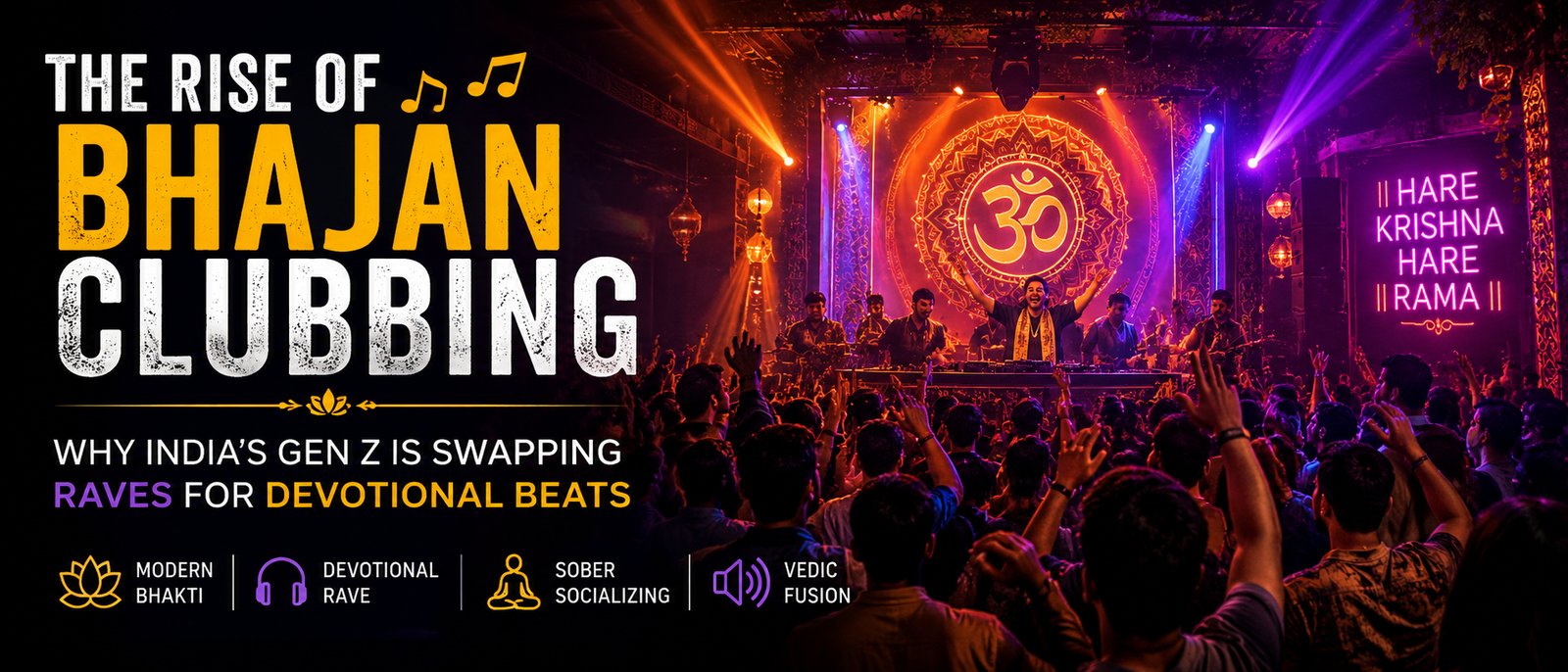
Bhajan Clubbing is a new form of India’s spiritual nightlife where devotional music, Sanskrit chants, and kirtans are remixed with electronic beats, immersive visuals, and concert-style energy—creating alcohol-free, high-energy gatherings that appeal strongly to Gen Z seeking connection, culture, and a “clean high.”
Bass Drops Meet Bhakti
At first glance, the venue feels like any upscale underground gig in Mumbai or Delhi. The lights pulse in amber and indigo. Smoke machines blur the crowd into silhouettes. A deep bassline reverberates through the room.
But then the chorus arrives.
Instead of EDM vocals or rap hooks, hundreds of young people chant “Hare Rama Hare Krishna” in unison. Hands rise not for shots, but for rhythm. Sneakers replace temple footwear. Hoodies mingle with kurtas. The dance floor becomes something between a rave, a satsang, and a collective emotional release.
This is Bhajan Clubbing—one of the most fascinating Gen Z India Trends reshaping urban culture.
Across India’s metros, a generation raised on Spotify playlists, burnout culture, and identity anxiety is gravitating toward a surprising alternative: Modern Bhakti. These gatherings combine devotional music with contemporary production, creating what many attendees describe as a spiritually uplifting yet socially vibrant experience.
And unlike conventional nightlife, the intoxication here is emotional, communal, and entirely sober.
What Exactly Is Bhajan Clubbing?
At its core, Bhajan Clubbing blends traditional Indian devotional music with contemporary electronic soundscapes.
Think:
- Sanskrit mantras layered over house beats
- Kirtans accompanied by synth pads and bass drops
- Live percussion fused with techno rhythms
- Candlelit dance floors instead of neon excess
The movement is also being called:
- Devotional Rave
- Vedic Fusion
- Spiritual Nightlife
- Bhajan Jamming
- Conscious Club Culture
While devotional music has always existed in India, the format has radically changed. Instead of quiet temple halls or family gatherings, these events happen in stylish venues, rooftop spaces, wellness festivals, and immersive music arenas.
For Gen Z, spirituality is no longer confined to ritual. It is becoming experiential, aesthetic, communal, and deeply social.
The ‘Clean High’ Philosophy
Why Gen Z Is Reconsidering Conventional Party Culture
One of the biggest drivers behind the rise of Bhajan Clubbing is the broader “sober-curious” movement among young Indians.
After years of associating nightlife with alcohol-heavy excess, many urban Gen Z audiences are actively searching for experiences that feel emotionally meaningful without the physical crash.
The appeal lies in what participants often call a “clean high.”
Unlike traditional clubbing, where the aftermath can involve exhaustion, anxiety, or emotional numbness, devotional gatherings promise something different:
- Emotional release without intoxication
- Social connection without performative partying
- Euphoria without chemical dependency
- Community without judgment
In cities where hustle culture dominates daily life, these spaces function almost like emotional decompression chambers.
The Science of Collective Chanting
Psychologists and sociologists often refer to the phenomenon of synchronized group emotion as “Collective Effervescence.” Coined by sociologist Émile Durkheim, the term describes the heightened sense of unity and transcendence people feel during communal rituals.
Bhajan Clubbing taps directly into this dynamic.
When hundreds of people chant the same mantra in rhythm, the experience can create:
- heightened emotional synchronization,
- reduced social inhibition,
- and a powerful sense of belonging.
Unlike algorithm-driven digital connection, the experience is intensely physical and human.
The repetition of chants, the vibration of percussion, and the immersive sonic environment create a meditative state that many attendees describe as therapeutic.
For a generation battling loneliness, overstimulation, and digital fatigue, this matters.
Inside India’s New Spiritual Nightlife
A Different Kind of Weekend Scene
Traditional nightlife often revolves around exclusivity: VIP tables, expensive alcohol, curated appearances.
Spiritual Nightlife, by contrast, feels radically inclusive.
At a typical Bhajan Clubbing event, you might see:
- startup founders dancing beside college students,
- yoga practitioners beside hardcore music fans,
- spiritual seekers beside curious first-timers.
The atmosphere is energetic, but softer in tone. Less transactional. Less performative.
The crowd sings together rather than merely consuming entertainment.
And importantly, there is no pressure to appear detached or ironic—a defining shift in Gen Z culture globally. Emotional openness has become socially acceptable again.
The Rise of Sober Socializing in India
India’s younger urban demographic is increasingly experimenting with wellness-oriented lifestyles:
- alcohol-free events,
- sound healing sessions,
- meditation festivals,
- breathwork circles,
- and conscious community gatherings.
Bhajan Clubbing sits at the intersection of all these trends.
It transforms spirituality from obligation into lifestyle.
And unlike previous generations, Gen Z approaches faith with customization rather than rigid adherence. They are less interested in institutional religion and more interested in emotional resonance.
That distinction is crucial.
Artists Turning Ancient Chants Into Modern Anthems
The Backstage Siblings
Among the most recognizable names in the movement are the Backstage Siblings, whose performances combine devotional lyricism with contemporary production aesthetics.
Their appeal lies in accessibility.
Rather than presenting bhajans as formal or distant, they reinterpret them through layered instrumentals, cinematic sound design, and crowd-interactive performances that resonate with younger audiences.
The result feels less like religious instruction and more like immersive cultural storytelling.
Nirvaan Birla
Another major figure shaping the Modern Bhakti landscape is Nirvaan Birla, who has helped popularize devotional music among urban youth audiences.
His performances merge live spirituality with large-scale stagecraft, creating an atmosphere that feels simultaneously sacred and contemporary.
By integrating EDM textures, ambient production, and devotional chanting, artists like Birla are effectively building a new musical category: one where tradition and nightlife no longer oppose each other.
The Sound of Vedic Fusion
The music itself often draws from multiple genres:
- ambient electronica,
- Afro-house rhythms,
- live tabla,
- techno bass structures,
- folk melodies,
- and Sanskrit mantra loops.
This Vedic Fusion aesthetic reflects a larger truth about Gen Z India Trends: young audiences no longer see cultural purity as the goal.
Hybrid identity is the point.
Conventional Clubbing vs. Bhajan Jamming
| Aspect | Conventional Clubbing | Bhajan Jamming |
|---|---|---|
| Atmosphere | Loud, transactional, image-focused | Communal, immersive, emotionally open |
| Primary Beverage | Alcohol-heavy | Herbal drinks, mocktails, tea |
| Music Style | EDM, hip-hop, commercial mixes | Mantras, kirtans, Vedic Fusion |
| Emotional Goal | Escapism | Connection and grounding |
| After-effect | Hangover, fatigue | Calmness, emotional uplift |
| Social Dynamic | Fragmented groups | Collective participation |
| Energy Source | External stimulation | Group chanting and rhythm |
The comparison reveals why many young Indians see Bhajan Clubbing not merely as entertainment, but as a lifestyle correction.
Cultural Reclamation Without Rigidity
Why This Trend Feels Different
For decades, many urban Indian youth associated spirituality with obligation, conservatism, or generational pressure.
Bhajan Clubbing changes the emotional framing.
It allows Gen Z to reconnect with cultural heritage on their own terms.
There is no strict dress code.
No moral policing.
No demand for orthodoxy.
Instead, the atmosphere emphasizes curiosity, inclusivity, and emotional experience.
This is less about religion as institution and more about identity as exploration.
In many ways, the trend mirrors global movements where younger generations reinterpret tradition through modern aesthetics—from gospel house music in the West to Buddhist electronic festivals in East Asia.
But India’s version feels uniquely rooted in sound.
Because devotional music has always been participatory in Indian culture, the transition into communal nightlife feels surprisingly organic.
Reclaiming Indian Identity in a Globalized Era
For many urban Indians raised on Western nightlife templates, Bhajan Clubbing also represents cultural confidence.
It says:
Indian music traditions are not outdated.
Ancient chants can coexist with cutting-edge production.
Spirituality can feel modern.
This matters profoundly in an era where Gen Z increasingly seeks authenticity over imitation.
The Global Expansion of the Devotional Rave
What began in India is now spreading rapidly across diaspora communities.
In cities like London and New York City, Indian-origin communities are organizing mantra nights, conscious dance events, and Devotional Raves that blend spirituality with nightlife culture.
These gatherings often attract not only South Asians but multicultural audiences interested in wellness, yoga culture, and alternative music experiences.
The appeal is universal:
- emotional connection,
- rhythm-driven transcendence,
- and community without intoxication.
As wellness culture continues to expand globally, India’s Modern Bhakti movement may become one of the country’s most influential cultural exports.
Why Bhajan Clubbing Resonates So Deeply With Gen Z
Several cultural forces are converging at once:
1. Burnout Culture
Young professionals increasingly crave restoration rather than overstimulation.
2. Digital Fatigue
People want embodied, real-world connection after years of algorithmic socializing.
3. Identity Exploration
Gen Z is more willing to reinterpret heritage creatively.
4. Wellness Integration
Spirituality and mental health are no longer separate conversations.
5. Community Hunger
Shared chanting creates rare moments of emotional unity in fragmented urban life.
Together, these forces make Spiritual Nightlife feel less like a niche trend and more like a generational shift.
The Future of Modern Bhakti
The rise of Bhajan Clubbing reveals something larger than a nightlife preference.
It reflects a transformation in how young Indians understand joy, culture, and belonging.
For years, urban aspiration in India often mirrored Western club culture—exclusive venues, intoxication, curated coolness. But Gen Z is increasingly redefining what fulfillment looks like.
The future may not belong entirely to silent meditation retreats or chaotic nightclubs.
It may belong to hybrid spaces:
where bass meets mantra,
where community replaces performance,
and where spirituality becomes social rather than solitary.
As Modern Bhakti continues evolving, it is likely to influence:
- music festivals,
- wellness tourism,
- youth spirituality,
- nightlife design,
- and even mainstream entertainment.
What once sounded paradoxical—a devotional rave—is quickly becoming one of the defining Gen Z India Trends of the decade.
And on dance floors across India, ancient chants are finding new life through modern speakers.