Introduction: When a Village Grandmother Breaks the Internet
It doesn’t happen often. A Tamil film quietly walks into theatres, carries no superstar action hero on its poster, has no earth-shaking item number in its trailer — and then proceeds to take the entire internet by storm. That is exactly what Thaai Kizhavi did when it released on February 27, 2026.
Within days, the film was everywhere. Review videos were flooding YouTube. WhatsApp forwards were sharing dialogues from its climax. Social media was awash with people tagging their mothers, their grandmothers, and their favourite strong women with one simple caption: “This is you.”
What makes this Thaai Kizhavi movie review different from the others is this — the film isn’t just a story. It is a mirror. And what it reflects back is something Tamil cinema has rarely dared to put at its centre: a fierce, flawed, unapologetically self-sufficient elderly woman who doesn’t need anyone’s sympathy or validation.
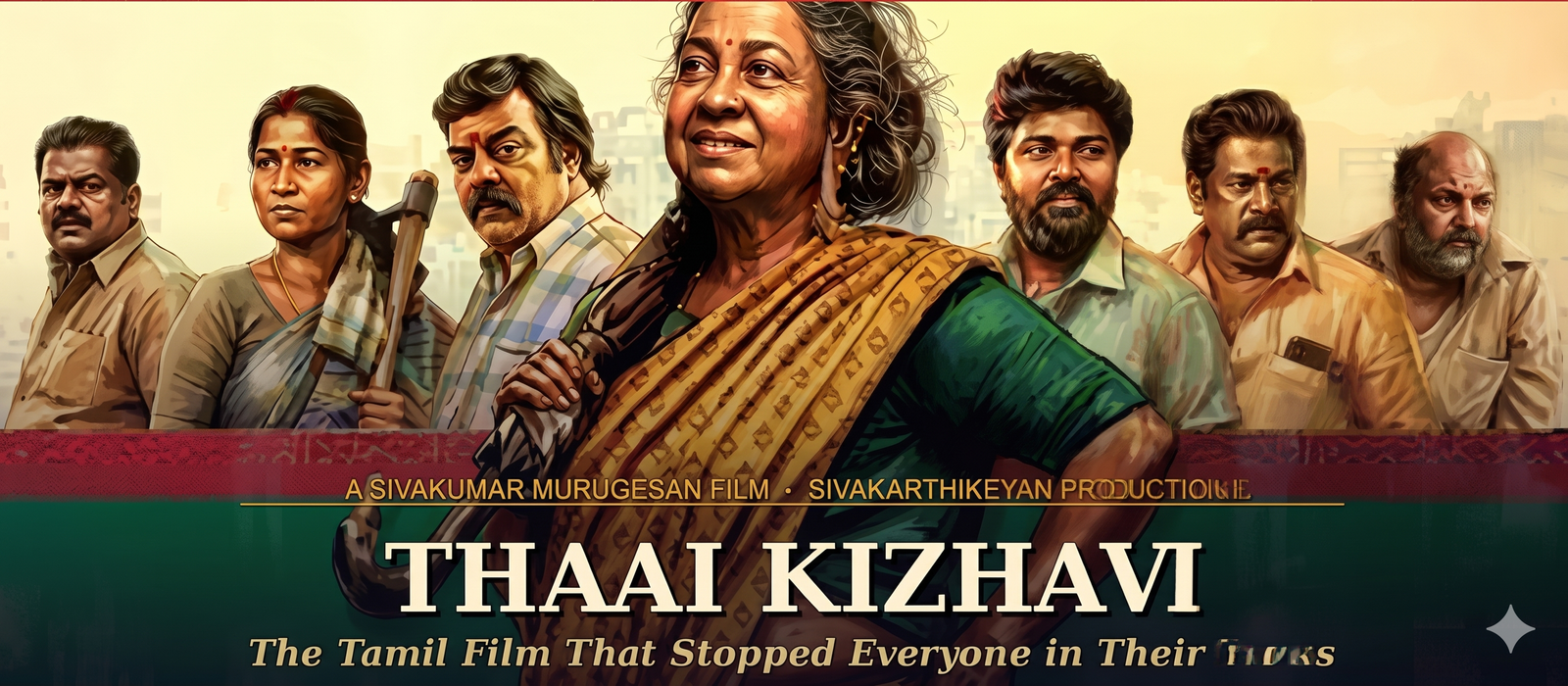
Backed by Sivakarthikeyan Productions and Passion Studios, directed by first-timer Sivakumar Murugesan, and carrying the full weight of the film on the shoulders of the legendary Radikaa Sarathkumar — Thaai Kizhavi is one of the most talked-about Tamil emotional drama films of recent memory. Here is why.
Plot Overview: A Woman Who Made Her Village Tremble — and Then Made You Think
Set in the dusty, sun-baked village of Kadupatti near Madurai, the film introduces us to Pavunuthaayi — a name that the entire village whispers with a mix of fear, irritation, and grudging respect. She is an aged moneylender. She is blunt to the point of being brutal. She has no patience for excuses, no interest in being liked, and absolutely no hesitation in dragging a debtor out of his own house in front of his family if the interest is due.
In short, she is the kind of woman the village would rather not run into on a Monday morning.
But when Pavunuthaayi suddenly falls ill and is confined to her bed, something unexpected happens. Her three sons — scattered, irresponsible, and largely absent from her life — come rushing back to the village. Not out of love. Not out of worry. But because word has gotten out that their mother secretly accumulated 160 sovereigns of gold during her years of quiet, stubborn financial independence. The sons want their share. What follows is a comedy of greed, misplaced priorities, and slow, dawning realisation that the woman they dismissed as difficult was, in fact, the most capable person in the room all along.
The plot is not revolutionary in its bones. But the way Sivakumar Murugesan tells it — with warmth, wit, and a perfectly timed emotional gut-punch in the final act — makes it feel fresh, relevant, and deeply satisfying.
Radikaa Sarathkumar: A Performance That Demands to Be Witnessed
There is performance. And then there is transformation. What Radikaa Sarathkumar does in Thaai Kizhavi is the second kind — rare, complete, and utterly convincing.
The actress, known for decades of sharp, memorable work in Tamil cinema, arrives here in a form that is almost unrecognisable. The prosthetic makeup alone is extraordinary — aged, textured, and entirely believable. But what makes the Radikaa Sarathkumar performance in Thaai Kizhavi truly exceptional isn’t the physical transformation. It’s what she does inside it.
Pavunuthaayi walks with the weight of a woman who has spent fifty years proving herself in a world that underestimated her. The slight forward lean of her posture, the clipped impatience in her voice, the way her eyes calculate a room the moment she enters it — Radikaa embeds a whole biography into the character’s body language. You don’t just see an old woman collecting debts. You see every sleepless night, every sacrifice quietly swallowed, every time she chose pragmatism over sentiment because sentiment didn’t pay the rent.
What is perhaps most impressive is how she handles the film’s tonal shifts. Thaai Kizhavi moves from broad rural comedy to genuine emotional depth, sometimes within the same scene. Radikaa navigates these transitions with a sureness that only decades of craft can produce. When the comedy lands, she is the reason it does. When the emotion catches you off guard in the second half, it is because she has been quietly, patiently building to it the whole time.
Multiple critics and audience members have noted that her character deserved even more screen time than the film gives her. That is perhaps the highest compliment a performance can receive — the audience wanting more is not dissatisfaction, it is hunger.
Direction and Storytelling: A Debut That Announces a New Voice
Sivakumar Murugesan comes to Thaai Kizhavi after working as an assistant director and screenwriter on films like Kadaisi Vivasayi and Aan Paavam Pollathathu. That background shows. He understands pacing. He understands how rural Tamil life looks and smells and sounds — the specific rhythm of a village morning, the texture of a communal argument, the way gossip moves faster than any newspaper.
The first half of the film is deliberately light on its feet. The comedy works through character — Pavunuthaayi’s sons are broad, bumbling archetypes, but they are written with just enough specificity to feel real rather than cartoonish. Singampuli, in the lead comic role, provides excellent foil energy, and the supporting ensemble of Aruldoss, Munishkanth, Bala Saravanan, and Ilavarasu gives the film the feel of a full, lived-in world.
Where Murugesan truly distinguishes himself is in the second half. The pacing slows — intentionally. The comedy retreats. The film’s real argument begins to surface. And by the time the climactic dialogues arrive — lines that speak directly about women, money, dignity, and what it means to build something of your own — the audience is not being lectured. They are being moved. That distinction is the difference between a filmmaker who has a message and one who has craft.
The film also makes clever, affectionate use of classic Kamal Haasan songs, weaving them into scenes with enough wit and precision that they feel organic rather than merely nostalgic. It is a small touch, but a telling one — this is a director who thinks about his audience, not just his screenplay.
Production and Cinematic Appeal: Small Budget, Big Heart
Made on a reported budget of approximately ₹10 crore, Thaai Kizhavi went on to gross over ₹81 crore worldwide in its theatrical run — a return on investment that few big-budget productions ever achieve. That number is not just a commercial statistic. It is a statement about what Tamil audiences will show up for when a film earns their trust.
Cinematographer Vivek Vijayakumar gives the film a warm, sun-soaked visual texture that suits the rural Madurai setting without over-aestheticising it. The village feels real, not picturesque — which is exactly right for a story this grounded.
Composer Nivas K. Prasanna’s music complements the film’s tonal range effectively. The background score adds quiet weight to the emotional passages without ever overselling them, and the songs are integrated into the narrative rather than interrupting it. For a comedy-drama of this kind, restraint in the music is a virtue, and Prasanna exercises it well.
Producer Sivakarthikeyan, whose production banner has championed small, story-driven films, continues a track record of backing projects that major studios might overlook. Along with co-producer Sudhan Sundaram under Passion Studios, the film represents exactly the kind of risk-taking that the Tamil film industry needs more of — and the box office numbers confirmed that audiences agree.
Key Themes: More Than a Grandmother Story
At its surface, Thaai Kizhavi is a comedy about a fierce old woman and her clueless sons. Look a little deeper, and it becomes something considerably more interesting.
The film’s central argument is about financial independence for women — not as a modern buzzword, but as something Pavunuthaayi has lived, fought for, and quietly protected her entire life. One of the film’s most quoted dialogues makes the point plainly: money may not buy everything in this world, but for a woman, it buys respect. The line lands because the film has spent two hours showing you exactly why it is true, not just telling you.
Beyond that, Thaai Kizhavi is a film about the gap between how a person is perceived and who they actually are. Pavunuthaayi is feared, disliked, called difficult and ruthless. But peel back the exterior and you find a woman who raised children largely on her own, built financial security through sheer discipline when no one was watching, and asked for nothing in return except to be left alone to live on her own terms. Whether that makes her admirable, complicated, or both is a question the film wisely leaves open.
It also, quietly, asks something of its male characters and its male audience. The sons’ greed is played for comedy, but it is never entirely comfortable comedy. The film doesn’t let them entirely off the hook, and in that gentle persistence, it lands its social commentary far more effectively than any sermon could.
Audience Reaction and Cultural Impact: The Conversation It Started
Thaai Kizhavi arrived in theatres on February 27, 2026, and ran for seven consecutive weeks — an achievement that speaks entirely to word-of-mouth. No franchise name. No single superstar driving footfall. Just one unforgettable character, a story that resonated, and audiences telling other audiences to go and see it.
On social media, the film sparked multiple conversations simultaneously. Many viewers celebrated it as a women’s empowerment story, a rare Tamil film that centres an elderly woman’s inner life and treats her autonomy as something worth fighting for. Others engaged more critically with questions about caste, class, and the moral complexity of a moneylender as protagonist — debates that the film itself, to its credit, does not entirely shut down.
That a mainstream rural comedy-drama was generating this kind of nuanced discussion is itself significant. Thaai Kizhavi is now streaming on JioHotstar, available in Tamil, Telugu, Malayalam, Kannada, and Hindi — which means its audience is only growing. The conversations around it are spreading with the same quiet inevitability as Pavunuthaayi herself, moving through a village that didn’t quite know what to make of her.
Conclusion: The Old Woman the Tamil Screen Needed
There is a scene near the end of Thaai Kizhavi that this review will not describe in detail. But it is the kind of scene that stays with you on the drive home, that makes you think about the women in your own life who built things quietly, who were called difficult when they were actually just determined, who earned their authority the hard way and never once asked for applause.
This is the latest Tamil movie of 2026 that proves, once again, that the most powerful stories don’t need the biggest budgets. They need the right character, the right actor, and a director who trusts both.
Radikaa Sarathkumar gives what may be the performance of her career. Sivakumar Murugesan announces himself as a filmmaker worth watching. And Thaai Kizhavi, for all its laughter and lightness, leaves behind something that lingers — a quiet, stubborn insistence that a woman’s independence is not a side story. It is the whole story.
Pavunuthaayi would not ask you to watch this film. She would expect you to.
Thaai Kizhavi is now streaming on JioHotstar in Tamil and multiple dubbed languages. If you’ve already watched it, share the moment that hit you hardest — because chances are, someone else felt exactly the same thing.