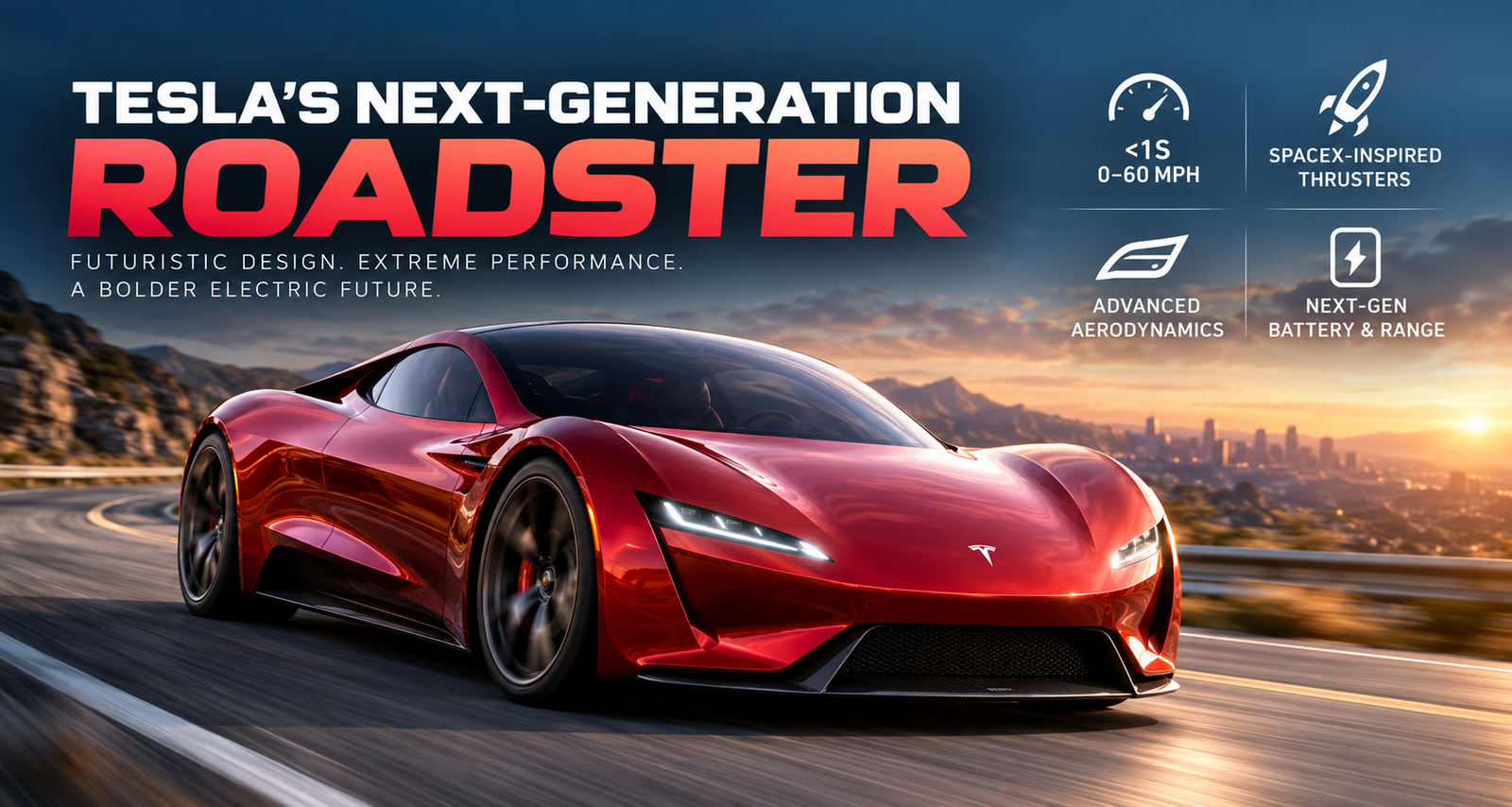
Tesla has consistently challenged traditional ideas about what a car should be. From making electric vehicles desirable to introducing advanced software-driven driving experiences, the company has played a significant role in transforming the automotive industry. Its next-generation Roadster aims to push the boundaries of electric performance with extreme acceleration, futuristic styling, advanced aerodynamic systems and SpaceX-inspired propulsion technology.
One of the most remarkable claims surrounding the new Tesla Roadster is its ability to accelerate from 0 to 60 mph in less than one second in its specialised Thrust configuration. Tesla has also presented advanced concepts involving cold-gas thrusters and a suction-based system designed to enable extraordinary manoeuvres.
However, the Roadster is not simply about speed. Its design, lightweight construction, digital cockpit and performance-focused engineering demonstrate Tesla’s ambition to create a vehicle that challenges conventional ideas about electric supercars.
With production targeted for 2028, the next-generation Roadster has attracted attention from automotive enthusiasts, technology followers and electric vehicle fans worldwide. Here is a detailed look at its expected features, performance capabilities, design and potential market impact.
1. Extreme Acceleration and Electric Performance
Acceleration is one of the defining features of the Tesla Roadster. Electric motors can deliver torque almost immediately, eliminating the need for traditional gear changes and allowing rapid power delivery.
Tesla’s original second-generation Roadster concept promised acceleration from 0 to 60 mph in 1.9 seconds. The updated Roadster programme takes this ambition further, with Tesla claiming that the specialised Thrust configuration can accelerate from 0 to 60 mph in less than one second.
What Makes the Acceleration Possible?
Several engineering factors contribute to the Roadster’s performance ambitions:
- Instant electric torque helps deliver rapid acceleration without traditional gear changes.
- Advanced traction management controls power delivery to maximise available tyre grip.
- Aerodynamic optimisation is designed to improve stability and traction at speed.
- Lightweight materials such as carbon fibre, magnesium and titanium can help reduce vehicle mass.
- Cold-gas thrusters in specialised configurations are intended to supplement the conventional electric drivetrain.
The sub-one-second acceleration claim should be understood in context. Tesla’s advertised capability needs to be distinguished from independently verified production-car performance. Nevertheless, it illustrates how electric vehicle engineering continues to challenge expectations about sports car acceleration.
2. SpaceX-Inspired Cold-Gas Thrusters
One of the most unusual features of the next-generation Tesla Roadster is its proposed use of cold-gas thrusters. Inspired by aerospace technology associated with SpaceX, this system is intended to supplement the vehicle’s electric performance capabilities.
How Do Cold-Gas Thrusters Work?
Cold-gas propulsion uses gas stored under pressure. When the gas is released through a nozzle, it produces thrust in the opposite direction. Unlike conventional rocket engines, cold-gas thrusters do not require combustion to generate thrust.
In specialised Roadster configurations, this technology is intended to provide additional acceleration and support experimental vehicle manoeuvres.
Potential applications include additional forward thrust, specialised directional manoeuvres and the more ambitious movement capabilities proposed for the Rocket configuration.
Will the Tesla Roadster Actually Fly?
Tesla has presented a prototype performing airborne manoeuvres using specialised thruster technology. The Rocket configuration is described as capable of upward and lateral movement.
However, this should not be confused with a conventional flying car. A vehicle that briefly lifts or performs a controlled manoeuvre using thrust is different from an aircraft capable of sustained, independently certified flight.
Tesla states that the Rocket configuration is not approved for public-road use. Its actual capabilities, safety requirements and regulatory status will depend on the final engineering and applicable regulations.
3. Tesla Roadster Performance, Thrust and Rocket Configurations
Tesla’s updated Roadster programme features different configurations intended to offer different levels of performance and technological ambition.
Performance Configuration
The Performance configuration is intended to combine extreme driving capability with a conventional road-oriented experience. Announced features include seating for two, active aerodynamic components, a multi-mode suction system designed to improve traction, and performance-focused engineering.
This configuration is aimed at buyers who want a high-performance electric sports car without the additional complexity of the specialised thruster system.
Thrust Configuration
The Thrust configuration adds cold-gas thrusters to the vehicle’s performance package. Tesla positions it as a more extreme option, combining the suction system with additional propulsion technology.
Tesla claims this configuration can accelerate from 0 to 60 mph in less than one second. The Thrust version is described as a limited-release configuration with seating for two.
Rocket Configuration
The Rocket configuration represents the most ambitious version of the Roadster concept. Tesla describes it as a single-seat vehicle featuring cold-gas thrusters positioned around the vehicle’s perimeter to enable additional directional and upward thrust.
The company presents it as an invitation-only configuration that is not approved for public-road use. Its proposed capabilities make it fundamentally different from an ordinary production supercar.
These configurations remain subject to final engineering, production specifications and availability.
4. Advanced Aerodynamics and the Multi-Mode Suction System
Aerodynamics plays an essential role in high-performance vehicle engineering. At high speeds, airflow affects stability, tyre grip, braking performance and cornering ability.
Tesla’s next-generation Roadster introduces a suction-based downforce concept designed to manage airflow beneath the vehicle.
What Is a Suction-Based Downforce System?
Traditional performance cars use spoilers, wings, splitters and carefully shaped underbodies to generate downforce. Downforce pushes a vehicle towards the road, helping its tyres maintain grip.
A powered suction system can use fans and ground-sealing components to create a low-pressure region beneath the vehicle. This is intended to generate downforce without relying entirely on forward speed.
The system is designed to improve traction during demanding driving conditions. Tesla has also presented extraordinary manoeuvres involving this technology, although the final production system’s capabilities require verification.
Active Aerodynamic Components
The Roadster features active aerodynamic elements, including a rear wing that can change position according to driving requirements.
High-downforce settings can prioritise grip and stability during aggressive cornering, while lower-drag settings can reduce aerodynamic resistance at speed. Adaptive control is intended to balance traction, efficiency and stability.
The actual benefits will depend on the final system, its control software and operating conditions.
5. Futuristic Exterior Inspired by Aerospace Design
The next-generation Tesla Roadster features a low-slung body, sculpted surfaces and distinctive sports car proportions. Its design combines minimalist styling with technical details inspired by aerospace engineering.
Hidden Headlights and Integrated Lighting
The vehicle uses concealed headlights and a full-length rear taillight design. Integrating lighting into the bodywork helps maintain a clean exterior appearance while reinforcing its futuristic character.
Flush-Mounted Aerodynamics
The exterior incorporates aerodynamic elements into the vehicle’s surfaces rather than relying entirely on separate attachments. This approach supports a streamlined appearance and the Roadster’s performance-focused design philosophy.
Aerospace-Inspired Finishes
Tesla has presented finishes such as Ano White, tinted glass inspired by spacesuit visors and titanium accents. These details reinforce the connection between automotive and aerospace design.
The final production vehicle’s exterior materials, finishes and available colours may differ from the concepts shown during presentations.
6. Lightweight Materials and Performance Engineering
Weight is a critical consideration in a high-performance electric vehicle. Battery packs, electric motors and structural safety systems add mass, making lightweight engineering particularly important for electric supercars.
Why Do These Materials Matter?
Carbon fibre offers a high strength-to-weight ratio and is widely used in performance vehicles to reduce mass. Magnesium can provide lightweight component solutions when used in appropriate applications. Titanium offers high strength and corrosion resistance, making it suitable for selected performance components.
Reducing unnecessary weight can help improve acceleration, braking response, cornering and energy efficiency.
Tesla has also described a weight-conscious interior featuring fixed seat positions and manual controls. These design decisions aim to reduce the mass and complexity associated with certain adjustment mechanisms.
7. A Digital Cockpit With Steer-by-Wire Technology
Tesla is known for its software-focused approach to vehicle interiors, and the next-generation Roadster continues this philosophy. Its cabin is designed around a minimalist layout that places driving information and essential controls at the centre of the experience.
Yoke-Style Steering
Tesla has presented a yoke-style steering interface designed for steer-by-wire technology. In a steer-by-wire system, electronic controls translate steering inputs into commands for the vehicle’s steering mechanism rather than relying exclusively on a conventional mechanical steering connection.
Such systems can allow engineers to adjust steering response according to driving conditions. Their implementation requires carefully engineered redundancy, fault handling and safety controls.
Multiple Displays
The interior concept features a central touchscreen supported by two smaller forward displays. These screens are intended to present key driving information and vehicle functions in a streamlined layout.
Potential uses include displaying speed, performance information, vehicle settings and other driving-related data. Final software functions may vary by production version.
A Driver-Focused Cabin
The Roadster is designed around a focused driving experience rather than an elaborate traditional luxury interior. Fixed seat positioning, lightweight materials and simplified controls support its performance-oriented design philosophy.
8. Battery Technology, Range and Charging Expectations
Battery performance is one of the most important aspects of any electric vehicle. For the Roadster, the challenge is to provide useful driving range while also delivering extremely high power during acceleration.
Tesla’s original second-generation Roadster website advertised a range of approximately 620 miles, or around 1,000 kilometres, and a top speed exceeding 250 mph. These figures belonged to the earlier proposal and should not automatically be treated as confirmed specifications for the updated production vehicle.
What Determines Electric Supercar Range?
Several factors influence the driving range of a high-performance electric vehicle:
- Battery capacity and energy density.
- Vehicle weight.
- Aerodynamic drag.
- Tyre selection and rolling resistance.
- Driving speed and acceleration frequency.
- Temperature and climate-control use.
- Battery management and thermal systems.
A vehicle designed for extreme acceleration may consume considerably more energy during aggressive driving than during steady cruising. Its real-world range will depend on battery technology, aerodynamics, driving conditions and usage.
Charging Speed
High charging speeds can make electric performance cars more practical for longer journeys, provided the vehicle and charging station support them. Tesla’s broader charging ecosystem is an important part of its electric vehicle strategy.
Buyers should wait for confirmed Roadster-specific charging rates, compatible hardware and charging-time measurements before making assumptions about its capabilities.
9. Removable Roof Panels and Open-Air Driving
Despite its performance-focused design, the Roadster is intended to offer an open-air driving experience. Tesla’s earlier second-generation Roadster concept featured a removable glass roof that could be stored in the vehicle. The updated design also incorporates removable roof panels.
This approach offers drivers the option of enjoying a more open cabin without requiring a permanently exposed convertible roof. The final roof configuration, storage arrangements and weather-sealing details should be confirmed against the production vehicle.
10. What Makes the Tesla Roadster Different From Other Electric Supercars?
The electric supercar segment has become increasingly competitive, with manufacturers exploring higher power outputs, advanced battery systems, torque vectoring and sophisticated aerodynamic engineering.
The Tesla Roadster’s differentiation comes from combining several technologies rather than relying on a single headline specification.
Key Features at a Glance
- High-performance electric propulsion.
- A claimed sub-one-second 0–60 mph acceleration target for the Thrust configuration.
- Active aerodynamic components and a powered suction system.
- Cold-gas thrusters on specialised configurations.
- Lightweight materials, including carbon fibre, magnesium and titanium.
- A yoke-style steering interface designed for steer-by-wire.
- Minimalist automotive styling with aerospace influences.
- A specialised Rocket configuration designed for experimental manoeuvres.
Competitors such as Rimac and other high-performance electric vehicle manufacturers focus on extreme acceleration, advanced power electronics and track-oriented engineering. Tesla’s Roadster takes a different direction by incorporating SpaceX-inspired propulsion and a suction-based downforce concept into its performance programme.
A direct performance comparison should wait until independent tests, production specifications and comparable measurement conditions are available.
11. Expected Launch Timeline and Availability
The next-generation Roadster has been one of Tesla’s most anticipated projects for years. The company originally announced its second-generation concept in 2017, and its production schedule has shifted repeatedly since then.
Following the October 2026 unveiling, Tesla’s stated production target is 2028. This target does not guarantee that every configuration will reach customers at the same time.
Manufacturing readiness, engineering validation, supply-chain requirements and regulatory approvals may influence the final schedule. The specialised Rocket configuration presents additional challenges because its proposed capabilities go beyond those of a conventional road vehicle.
Prospective buyers should distinguish between a public unveiling, a reservation, a confirmed production specification and an actual customer delivery.
12. What Could the Tesla Roadster Cost?
A final, universally confirmed retail price for the newly unveiled production vehicle has not been established. The Roadster is positioned as a premium performance product, and specialised propulsion systems could make certain configurations more complex than ordinary electric sports cars.
Its eventual pricing may depend on the selected configuration, battery and drivetrain specifications, specialised hardware, regional taxes, import duties and production volumes.
Earlier Roadster announcements included pricing expectations that should not automatically be applied to the latest vehicle. Anyone considering a reservation should review the current official terms carefully, including the deposit, refund conditions, final pricing provisions and delivery disclaimers.
13. Will the Tesla Roadster Launch in India?
Interest in Tesla vehicles continues to grow in India, particularly among consumers following premium electric cars and automotive technology. However, an international unveiling does not automatically mean that a vehicle will be available in every market.
A confirmed India-specific customer delivery schedule for the new Roadster has not been established. Several factors could influence its availability in India.
Import Duties and Pricing
Imported high-performance vehicles can become significantly more expensive after applicable duties and taxes. The final Tesla Roadster price in India will depend on official pricing and the applicable import and tax structure.
Right-Hand-Drive Production
India generally requires right-hand-drive vehicles for normal passenger-car use. Tesla’s production and delivery plans for this configuration need to be confirmed.
Road Approval and Safety
Road-focused versions would need to comply with applicable Indian vehicle regulations. The Rocket configuration’s specialised manoeuvring capabilities raise additional road-use and safety questions.
Charging Infrastructure
Access to compatible high-power charging infrastructure could affect the ownership experience. Prospective buyers should wait for official confirmation of the vehicle’s charging requirements and Indian availability.
14. Challenges Tesla Must Overcome
The Roadster’s ambitious feature list also raises important engineering and commercial questions.
Making Extreme Performance Repeatable
Achieving a dramatic performance result in a demonstration is different from delivering the same result repeatedly under normal operating conditions. Battery temperature, tyre grip, vehicle mass and environmental conditions can all affect acceleration.
Safety and Regulatory Compliance
A conventional road car must satisfy extensive requirements involving braking, steering, occupant protection, lighting and other systems. Additional propulsion technology introduces further questions about safe operation, maintenance, emergency procedures and public-road legality.
Turning Prototypes Into Production Vehicles
Concept vehicles can demonstrate ambitious ideas, but mass production requires repeatable manufacturing processes, quality control, serviceability and dependable component supply.
Delivering on the Timeline
Given the Roadster’s long development history, production timing remains an important point to watch. The 2028 target is a stated expectation, not a guarantee of customer delivery on a particular date.
15. Why the Next-Generation Roadster Matters for the Future of Electric Cars
The Roadster represents more than another addition to Tesla’s vehicle lineup. High-performance cars often act as technology showcases, allowing manufacturers to explore materials, propulsion systems, thermal management, software and aerodynamics that may influence future engineering.
The Roadster could contribute to the development and discussion of several technologies:
- High-power electric drivetrains.
- Advanced active aerodynamic systems.
- Lightweight vehicle construction.
- Integrated electronic steering systems.
- Performance-focused battery management.
- Novel approaches to vehicle stability and propulsion.
Not every experimental feature will necessarily become common in everyday cars. Nevertheless, ambitious vehicle development can help expand the boundaries of automotive engineering.
The Roadster also illustrates how the electric vehicle industry is evolving. Competition is no longer limited to driving range and charging speed. Performance, software, design and distinctive technology are becoming increasingly important.
Frequently Asked Questions About the Tesla Roadster
1. What Is the Next-Generation Tesla Roadster?
The next-generation Tesla Roadster is an upcoming high-performance electric sports car featuring advanced aerodynamic systems, a minimalist digital interior and specialised SpaceX-inspired thruster technology in certain configurations.
2. How Fast Is the New Tesla Roadster?
Tesla claims that the Thrust configuration can accelerate from 0 to 60 mph in less than one second. This advertised capability should be distinguished from independently verified production-car performance.
3. Can the Tesla Roadster Fly?
Tesla describes the Rocket configuration as capable of upward and lateral movement using cold-gas thrusters. It is not a conventional aircraft, and Tesla states that this configuration is not approved for public-road use.
4. What Are the Tesla Roadster’s Main Configurations?
Tesla’s announced configurations include Performance, Thrust and Rocket. They are intended to offer different levels of road-focused performance and specialised propulsion capability.
5. When Will the New Tesla Roadster Be Available?
Tesla has indicated that production is expected to begin in 2028. Actual customer delivery dates and availability may vary, and the target is not a guaranteed delivery commitment.
6. What Is the Expected Price of the Tesla Roadster?
A final confirmed retail price for the newly unveiled production vehicle has not been established. Earlier announced prices should not automatically be applied to the latest model.
7. Will the Tesla Roadster Be Available in India?
An India-specific delivery timeline has not been confirmed. Pricing, import requirements, right-hand-drive availability and regulatory approval will affect its potential launch.
8. How Is the New Roadster Different From a Conventional Electric Sports Car?
Beyond high-performance electric propulsion, the Roadster explores powered suction-based downforce and cold-gas thrusters in specialised configurations. These technologies distinguish it from electric sports cars that rely exclusively on conventional wheel-driven propulsion.
Conclusion: A Glimpse Into Tesla’s Most Ambitious Sports Car Yet
The next-generation Tesla Roadster represents an ambitious attempt to combine electric performance with aerospace-inspired engineering. Its headline acceleration target, advanced aerodynamic systems, lightweight construction, digital cockpit and experimental thruster technology make it one of the most unusual vehicles in Tesla’s announced lineup.
At the same time, its future success will depend on more than dramatic demonstrations. Production readiness, verified performance, safety, regulatory compliance, pricing and customer delivery timelines will ultimately determine its place in the automotive market.
With production targeted for 2028, the Roadster remains a vehicle worth watching for anyone interested in electric mobility, automotive design and emerging vehicle technologies. The biggest question is not simply how fast the Roadster can accelerate, but how much of its ambitious engineering vision Tesla can successfully translate into a production vehicle.
Editorial note: Verify the latest official Tesla specifications, configuration details, production schedule and availability before publication, as announced features and timelines may change.
References
Tesla Roadster official website: https://www.tesla.com/roadster