Every year, as the streets of Mumbai come alive with the drums of Ganpati visarjan, thousands of devotees follow the majestic procession of Lalbaugcha Raja through the city.
The atmosphere is electric. Dhol-tasha beats fill the air. Devotees chant, “Ganpati Bappa Morya!” Streets overflow with people waiting for one final darshan before Bappa begins his journey towards the sea.
But somewhere along this long and emotional journey, there is a moment that feels different.
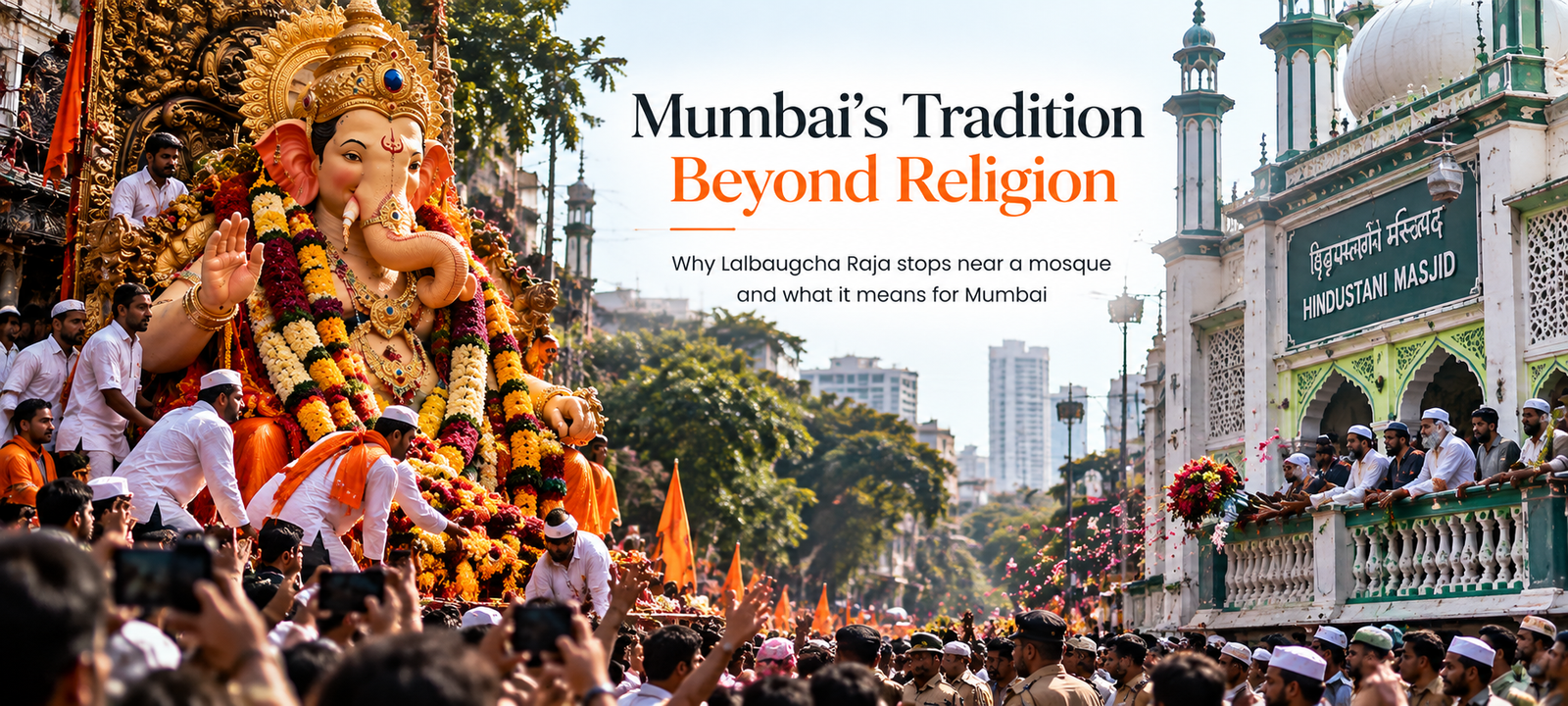
As Lalbaugcha Raja reaches Hindustani Masjid in Byculla, the procession pauses.
For a few moments, the sounds, the crowds and the movement of the procession give way to something quieter: a gesture of greeting and mutual respect between two communities.
And naturally, one question often comes up:
Why does Lalbaugcha Raja stop near a mosque?
A Pause That Became a Tradition
The stop at Hindustani Masjid is associated with the annual visarjan procession of Lalbaugcha Raja. When the procession reaches the mosque, members of the local Muslim community and mosque committee have traditionally come forward to welcome the procession.
Flowers are offered to the idol, greetings are exchanged, and sweets may be shared between people from the two communities. After this brief pause, the procession continues towards Girgaum Chowpatty for immersion.
Reports on the tradition describe it as a social and cultural practice that developed along the procession route rather than as a prescribed part of Hindu Ganesh rituals. Recent accounts also describe the local Muslim community’s role in welcoming and supporting the procession.
There is no religious requirement in Hindu ritual that says a Ganesh idol must stop at a mosque. Rather, the stop is understood as a local social tradition that developed along the procession route.
And perhaps that is what makes the moment so meaningful.
It was not created by a religious rulebook.
It was created by people.
How Did the Tradition Begin?
This is where the story becomes more nuanced.
Several accounts connect the tradition to gestures of cooperation from local Muslim residents and leaders along the Lalbaugcha Raja’s long visarjan route. Some recent reports say that local Muslim leaders helped facilitate the procession and maintain smooth movement along the route, particularly from the 1980s onward. Over time, that cooperation is said to have evolved into the familiar welcome at Hindustani Masjid.
However, the exact origin date is not consistently documented across available accounts. Some reports describe it as a decades-old tradition of goodwill, while others associate its development with cooperation between the local Muslim community and the Ganesh mandal during the procession.
That uncertainty does not take away from what the tradition represents today.
Because sometimes, the most meaningful traditions are not born on a particular date.
They grow slowly.
They are repeated.
And eventually, they become part of a city’s identity.
When Two Communities Share the Same Street
Mumbai has always been a city of movement.
People arrive here from different states, languages, cultures and faiths. They build businesses beside one another, live in neighbouring communities, share public spaces and celebrate their festivals in the same city.
The Lalbaugcha Raja procession passes through some of Mumbai’s busiest neighbourhoods before reaching the sea. Its route is not isolated from the city; it moves through the city.
And at Hindustani Masjid, that reality becomes visible.
A Hindu religious procession pauses outside a Muslim place of worship.
The mosque community welcomes the procession.
Flowers are exchanged.
Greetings are shared.
And then the journey continues.
There is something beautifully Mumbai about that.
More Than a Viral Moment
Photographs and videos of Lalbaugcha Raja stopping outside the mosque often circulate widely on social media, especially during Ganesh Chaturthi.
But reducing the moment to a viral “Hindu-Muslim unity” image misses something important.
The significance lies in the fact that it is not simply a staged photograph.
It is part of the rhythm of the procession.
Year after year, the same street becomes a meeting point for people of different faiths.
For devotees, it is part of Bappa’s journey towards visarjan.
For those welcoming the procession, it is a gesture of respect.
For the wider city, it has become a reminder that public spaces can bring different communities together.
The Beauty of Mumbai Is Often Found in Moments Like These
Mumbai is famous for its speed.
Local trains rush through stations. Traffic fills the roads. Markets remain busy. People are constantly moving from one destination to another.
Yet every year, during the Lalbaugcha Raja visarjan, the city pauses.
And at Hindustani Masjid, there is another pause within that pause.
For a brief moment, the destination does not matter.
The procession does not matter.
The crowd does not matter.
What remains is a simple human gesture:
“We see you. We respect you. You are part of this city too.”
Perhaps that is why this tradition continues to attract attention.
Because in a world that often focuses on differences, a few minutes on a Mumbai street can tell a much simpler story.
Different prayers.
Different traditions.
Different places of worship.
But the same city.
Lalbaugcha Raja and the Spirit of Mumbai
Lalbaugcha Raja has been a major part of Mumbai’s Ganeshotsav since the Lalbaugcha Raja Sarvajanik Ganeshotsav Mandal was established in 1934. Its annual procession has grown into one of the city’s most recognisable public religious and cultural events.
Yet perhaps one of the most memorable moments of that journey is not the arrival at the sea.
It is the moment when the procession stops beside a mosque.
Because sometimes, a city’s character is not revealed by its biggest celebrations.
It is revealed by what happens when two communities meet on the same street.
And in Mumbai, that meeting has become a tradition.
Ganpati Bappa Morya.
And perhaps, in its own quiet way, this tradition says something equally powerful:
Mumbai belongs to everyone.
Related Articles and Further Reading
- Mumbai’s Lalbaugcha Raja stops at this mosque every year during Anant Chaturdashi procession – Moneycontrol
- Why Does Mumbai’s Lalbaugcha Raja Halt at This Masjid Every Visarjan? – Free Press Journal
- Why Does Lalbaugcha Raja Halt at Hindustani Masjid? – TV9 Marathi
- Why Does Lalbaugcha Raja Stop in Front of Hindustani Masjid Every Year? – HerZindagi
- Lalbaugcha Raja Procession: A Tradition That Unites Communities in Mumbai – ABP Live
- Lalbaugcha Raja Visarjan Route and Key Stops – Free Press Journal
Frequently Asked Questions
Why does Lalbaugcha Raja stop near a mosque?
The Lalbaugcha Raja visarjan procession traditionally pauses at Hindustani Masjid in Byculla. Published accounts describe the stop as a long-running gesture of respect and goodwill involving the local Muslim community.
Which mosque does Lalbaugcha Raja stop at?
The procession stops near Hindustani Masjid in Byculla, Mumbai, along its route towards Girgaum Chowpatty.
Is stopping at the mosque part of a Hindu religious ritual?
No. The stop is generally described as a social and cultural tradition associated with the procession rather than a prescribed Hindu religious ritual.
When did the tradition begin?
The exact starting date is not consistently documented. Several reports associate the tradition with cooperation between local Muslim residents or leaders and the Ganesh mandal during the procession, particularly from the 1980s onward.
What happens when the procession reaches the mosque?
Accounts describe members of the local Muslim community or mosque committee welcoming the procession. Flowers and garlands may be offered, greetings exchanged and sweets shared before the procession continues towards the immersion point.
Where does Lalbaugcha Raja eventually go for immersion?
The procession continues through several parts of South Mumbai before reaching Girgaum Chowpatty, where the idol is immersed.