Not long ago, Korean food in India was a niche obsession confined to a handful of expat-friendly restaurants in Delhi’s Majnu Ka Tila and a few adventurous eaters in Bangalore’s tech corridors. Today, the story is dramatically different. Walk into any trendy café in Hyderabad’s Banjara Hills, scroll through Instagram Reels for five minutes, or open Swiggy on a Friday night — Korean food is everywhere, and it is not leaving anytime soon.
The Korean cuisine trend in India has moved from fringe to formidable at a speed that has surprised even seasoned food industry veterans. Ramyeon bars have replaced salad counters. Korean corn dogs are being devoured in Mumbai food halls. Tteokbokki kits are landing on doorsteps via quick commerce in under 15 minutes. And bingsu — Korea’s shaved ice dessert — is giving good old kulfi some serious competition on Instagram.
What sparked this? A perfect storm of K-dramas on Netflix, the global dominance of K-pop, a generation of Indian consumers raised on social media, and a cuisine that — despite its 5,000-kilometre distance — feels strangely, warmly familiar. In 2026, Korean food isn’t a trend anymore. It’s a movement. And India is squarely at its centre.
1. How K-Dramas and K-Pop Sparked India’s Korean Food Obsession
To understand why Korean food popularity in India has skyrocketed, you need to start with a screen — specifically, a Netflix screen at 11 PM, with a bowl of Maggi substituting for the ramyeon a character on Crash Landing on You is slurping in a dimly lit Seoul kitchen.
That moment of watching — and wanting — is precisely where India’s K-food obsession was born.
The Hallyu wave, or Korean cultural wave, began washing over Indian shores around 2018 but hit peak force between 2020 and 2023, when pandemic lockdowns turned millions of Indians into binge-watchers. Netflix India reported a staggering year-on-year jump in K-drama viewership, and Euromonitor noted that Korean noodle imports into India grew by 162% in volume during 2020 alone — a direct reflection of viewers wanting to eat what they were watching.
BTS played an outsized role in this cultural seduction. The global K-pop phenomenon didn’t just make fans want to listen to their music — it made them want to eat what the group ate, wear what they wore, and live the Seoul lifestyle they projected. Indian BTS Army communities on Twitter and Discord became informal food discovery networks, sharing where to find dakgalbi, how to cook japchae, and which convenience store snacks to import from Korea.
Then came the mukbang culture — YouTube and Instagram live-streams of people eating vast quantities of Korean food with theatrical enjoyment. Indian content creators quickly adopted the format, and Korean dishes entered mainstream consciousness not through restaurants but through screens and smartphones. Viral challenges like the Korean Buldak (fire noodle) challenge racked up millions of views on Indian YouTube, turning ramyeon into something of a rite of passage for Gen Z.
The K-drama food trend, in particular, gave Korean cuisine an emotional halo. Food in K-dramas is never just food — it is comfort, love, grief, and belonging. That storytelling power translated seamlessly into India, a culture that understands, perhaps better than most, the profound emotional language of food.
2. Why Korean Food Feels Surprisingly Familiar to Indian Taste Buds
Here is the secret behind Korean food’s rapid adoption in India: it does not taste foreign. It tastes, in many delightful ways, like home.
The most obvious point of connection is spice. Korean cuisine is built on gochugaru (red chilli flakes) and gochujang (fermented chilli paste) — flavour profiles that hit the Indian palate with a satisfying, familiar burn. A plate of tteokbokki, Korea’s spicy rice cakes, lands on the tongue in a way that any south Indian who grew up eating chilli-laced curries would recognise instantly. The heat is different, but the love of heat is exactly the same.
Then there is the fermentation factor. India has a deep, ancient relationship with fermented foods — think kanji, gundruk, idli batter, pickle-making traditions across every regional cuisine. Kimchi, Korea’s iconic fermented cabbage, slips into this cultural context with surprising ease. Indian consumers who already appreciate the tang of achaar find kimchi’s funky, sour heat to be a natural extension of something they already love.
Rice is another invisible thread connecting the two cuisines. Bibimbap, the Korean mixed rice bowl, resonates in a country where rice is the cornerstone of daily life for hundreds of millions. A bowl of bibimbap — with its colourful vegetables, protein, and gochujang dressing — is not conceptually far from an Indian thali: a balanced, rice-centred meal with multiple accompaniments.
The shared comfort-food culture matters, too. Korean cuisine, like Indian food, is deeply rooted in communal dining, warmth, and the idea that cooking is an act of care. The Korean concept of jeong — an emotional bond formed over shared meals — mirrors the Indian understanding that food is how we express love. That philosophical similarity makes Korean food feel emotionally accessible in a way that, say, French haute cuisine simply does not.
3. The Rise of Korean Cafés and Korean BBQ Restaurants Across India
Five years ago, finding a decent Korean BBQ in India required either a flight to Seoul or a very specific trip to Majnu Ka Tila in Delhi. Today, the geography of Korean dining in India has expanded dramatically — and continues to grow at a pace that is turning heads in the restaurant industry.
Bangalore, India’s cosmopolitan tech capital, has become a hotbed for authentic Korean dining. Restaurants like Arirang have built loyal followings among the city’s globally-exposed IT workforce, serving everything from spicy tofu stew to sizzling galbi. Hyderabad is witnessing its own Korean café moment — spots like The Bibimbab Café are drawing Gen Z crowds with fusion menus that include kimchi pasta and Korean tacos alongside traditional dishes. Mumbai’s Bandra has Heng Bok, a restaurant that brings Seoul’s modern dining energy to India’s entertainment capital, while Pune’s Ssongchee has found an enthusiastic young audience with its K-pop-themed café format. Delhi remains the most established Korean dining hub, anchored by institutions like Gung The Palace in the heart of the city.
What is particularly interesting about the Korean café culture taking root in India is its aesthetic dimension. These are not just restaurants — they are experiences. Pastel interiors, neon Korean signage, DIY ramyeon stations, self-serve bingsu counters, and curated K-pop playlists create an immersive atmosphere that is tailor-made for Instagram. In a dining culture increasingly driven by the visual, Korean cafés offer an environment that is as shareable as it is edible.
The Korean convenience store concept — popularised globally through shows like Hometown Cha-Cha-Cha — is also finding Indian expression in hybrid café-stores that sell Korean snacks, instant ramen, soju-inspired beverages, and packaged kimchi alongside sit-down meals. This retail-dining hybrid is proving particularly successful in cities with large student populations.
Industry data supports the momentum. India’s full-service restaurant market is expected to grow from USD 37.93 billion in 2025 to USD 42.09 billion in 2026, with restaurants increasingly introducing niche Asian cuisines such as Korean and Japanese to cater to younger consumers. Korean dining is one of the fastest-growing sub-segments within this expanding market.
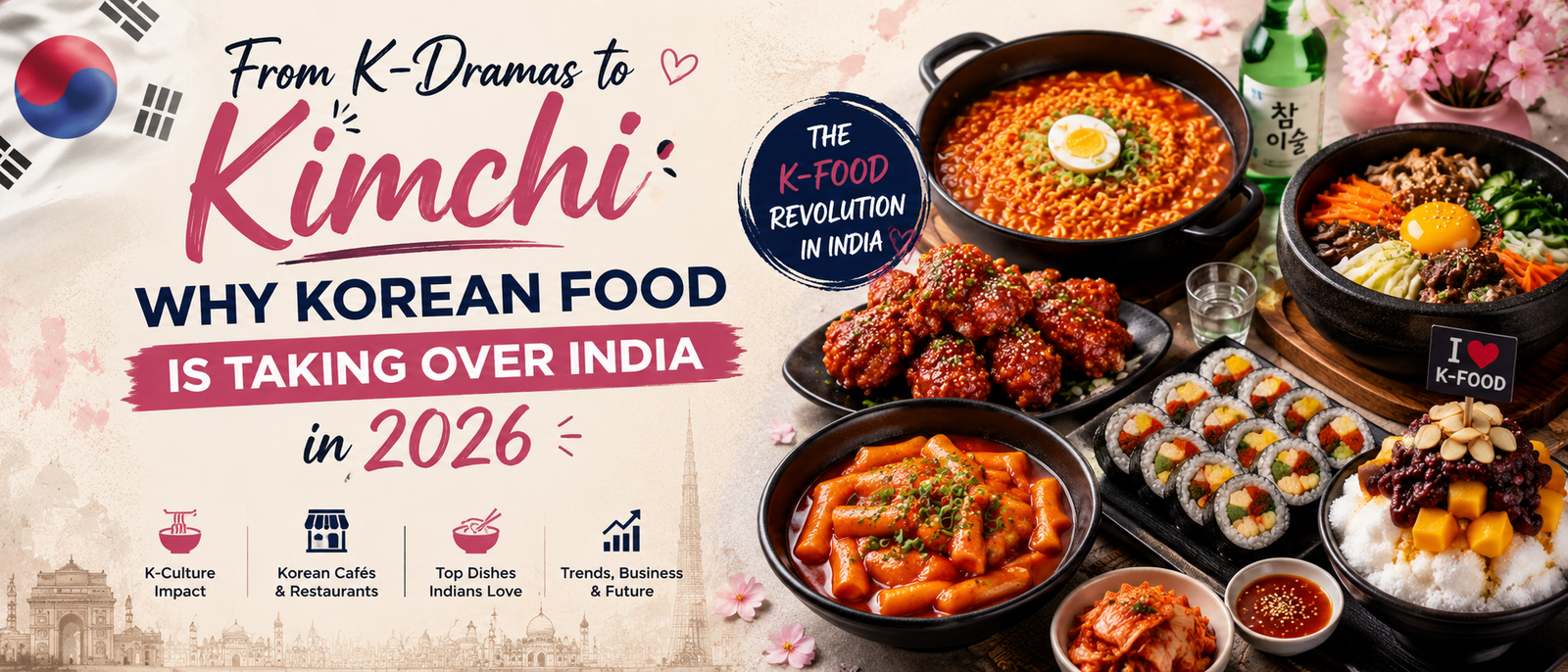
4. Most Popular Korean Dishes Indians Are Obsessed With
Not all Korean dishes have found equal traction in India. Here are the ones that have captured Indian hearts — and why.
Kimchi
India’s gateway fermented food. Kimchi’s spicy, tangy punch connects intuitively with a country that has always loved its achaar. It is now available in Indian supermarkets, served as a side dish in pan-Asian restaurants, and even made at home by adventurous cooks following YouTube tutorials.
Tteokbokki
These chewy, spicy rice cakes are perhaps the most viral Korean street food in India. Their “video value” — the dramatic stretch of gooey cheese, the vivid red sauce — makes them perfect social media content, and their comfort-food nature makes them deeply satisfying to eat.
Bibimbap
The Korean mixed rice bowl has found a natural home in India’s rice-loving culture. Light, balanced, and endlessly customisable, bibimbap has also attracted health-conscious urban consumers who see it as a nutritious, colourful meal. Its visual appeal — a rainbow of vegetables arranged over white rice — makes it one of the most-photographed Korean dishes in India.
Korean Fried Chicken
Double-fried, impossibly crispy, and coated in sticky-sweet or fiery glazes — Korean fried chicken has given Indian consumers a new benchmark for what fried chicken can be. It has become a staple on delivery platforms and is one of the most-ordered Korean dishes on Zomato and Swiggy.
Ramyeon
The Korean instant noodle has a different personality from Maggi — thicker, spicier, more theatrical. Buldak Ramen’s fire noodle challenge built its Indian fan base almost entirely through social media virality, and ramyeon now commands premium shelf space in urban supermarkets across India.
Japchae
Glass noodles stir-fried with vegetables and sesame — japchae has found admirers among India’s large vegetarian population for its light, flavourful profile. It offers a sophisticated alternative to Chinese-style noodles, and its visual elegance makes it a restaurant menu staple.
Korean Corn Dogs
Possibly the most Instagrammable food to arrive in India in years. A crispy fried exterior, molten cheese interior, and customisable toppings like sugar, ketchup, and mustard — Korean corn dogs are the street food crossover hit that Indian consumers have been waiting for.
Bingsu
Korea’s milk-based shaved ice dessert, piled high with red bean, matcha, or fruit toppings, has arrived at exactly the right cultural moment — as Indian consumers increasingly look for lighter, photogenic dessert alternatives to the traditional mithai spread.
5. Why Gen Z Is Driving the Korean Food Trend in India
Make no mistake: the Korean food Gen Z trend in India is not incidental. Gen Z — broadly, those born between 1997 and 2012 — is the architect of this movement, and understanding their motivations is essential to understanding where Korean food is headed in this country.
For Indian Gen Z, food is not nourishment alone. It is identity, expression, and content. A meal worth eating is almost always a meal worth posting, and Korean cuisine delivers on the visual front like few other cuisines do. The dramatic cheese pull of tteokbokki, the jewel-toned arrangement of a bibimbap bowl, the architectural height of a Korean corn dog — every dish is, in the language of this generation, deeply reel-worthy.
Fandom culture is another accelerant. K-pop fandoms in India are organised, passionate, and culturally influential. When BTS or BLACKPINK members are photographed eating a particular dish or visiting a specific restaurant, that dish can trend across Indian social media within hours. Food and fandom have become inseparably linked, and Korean restaurants that understand this — curating menus, playlists, and interiors that speak to K-pop culture — are winning the loyalty of this demographic decisively.
Gen Z also spends differently from previous generations. Experience-based dining — the idea of paying for an atmosphere, a story, and a shareable moment, not just a meal — is their dominant dining mode. Korean cafés, with their immersive aesthetics and interactive elements like DIY ramyeon stations and BBQ grills at the table, are purpose-built for this consumption pattern.
Influencer marketing has played a significant catalytic role. Indian food influencers with millions of followers have made Korean restaurant reviews and home-cooking tutorials a content staple, giving Korean cuisine a steady pipeline of organic, authentic-feeling endorsement that no traditional advertising budget could replicate.
6. How Food Delivery Apps Accelerated the Korean Food Boom
The Korean food delivery trend in India is, in many ways, the logistical backbone of this entire phenomenon. Without Swiggy and Zomato, Korean food’s reach would have remained confined to the handful of cities with dedicated Korean restaurants. Delivery platforms democratised access — and changed everything.
Today, Korean food is available on delivery platforms in virtually every major Indian city. Swiggy and Zomato have both introduced dedicated Korean and pan-Asian cuisine filters, reflecting genuine consumer demand. Korean fried chicken, ramyeon, and bibimbap consistently rank among the top-ordered Asian dishes on these platforms, with order volumes spiking notably on Friday and Saturday evenings — the classic comfort-food ordering window.
Quick commerce has taken this a step further. Platforms like Blinkit and Zepto now stock Korean instant noodles, gochujang, kimchi, Korean snacks, and even DIY tteokbokki kits for home delivery in under 15 minutes. This accessibility has enabled a generation of home cooks to experiment with Korean cuisine without the need for a speciality store — a significant barrier that previously existed.
The rise of Korean meal kit culture in India mirrors a global trend: consumers who want restaurant-quality Korean food but prefer the intimacy and control of cooking at home. Several Indian food startups have launched Korean-inspired meal kits — pre-portioned ingredients with recipe cards — that have found a ready market among young urban professionals.
The Korean instant noodle segment deserves special mention. Brands like Samyang’s Buldak Ramen have achieved cult status in India through a combination of social media virality and strategic e-commerce placement. They are now stocked not just in speciality stores but in mainstream supermarkets across metro cities — a clear indicator of mainstreaming at scale.
7. The Business Opportunity Behind Korea’s Food Wave in India
For restaurant owners, marketers, and entrepreneurs, the Korean food business in India represents one of the most compelling opportunities in the country’s food and beverage sector right now. The numbers and the cultural momentum align in a way that rarely happens simultaneously.
The K-food global market hit $13.6 billion in 2025, with ramyeon, kimbap, tteokbokki, and Korean BBQ identified as the four categories driving growth. India, with its young demographic, rising disposable incomes, and deep Korean cultural affinity, is positioned to capture a growing slice of this global expansion.
On the restaurant side, Korean BBQ is proving to be a high-ticket, high-experience format that justifies premium pricing. The DIY grilling element encourages longer table time, higher per-cover revenue, and built-in shareability — diners photograph themselves cooking, which is essentially free marketing. Restaurant groups that have cracked this format in Delhi, Mumbai, and Bangalore are already scouting locations for second and third outlets.
The Korean FMCG and snack import market is another compelling frontier. Korean snacks — from honey butter chips to Choco Pie variants to seaweed crisps — are increasingly available in Indian modern trade outlets and e-commerce platforms. As Korean cuisine transitions from a cultural phenomenon to a commercial powerhouse, the retail opportunity for Korean packaged food in India is substantial and largely untapped.
Korean fusion food is emerging as a particularly fertile commercial space. Restaurants that blend Korean techniques and flavours with Indian ingredients — think kimchi paratha, gochujang chicken tikka, or Korean-spiced vada — are finding enthusiastic responses from consumers who want the Korean experience wrapped in a local comfort layer. This fusion category is tailor-made for cloud kitchens, which can iterate menus quickly and reach consumers across city geographies without the overheads of a full-service restaurant.
For entrepreneurs looking at café franchises, the Korean café format — relatively lean on infrastructure costs, high on aesthetic appeal, and perfectly aligned with Gen Z dining behaviour — presents an attractive business model, particularly in tier-1 and rapidly urbanising tier-2 cities where the category is still nascent.
8. Is Korean Cuisine the Next Mainstream Food Category in India?
The question is no longer whether Korean food will grow in India. It already is. The more interesting question is: how mainstream will it go, and how fast?
The trajectory points unmistakably upward. Analysts and industry observers broadly agree that Korean cuisine is advancing through intentional global strategy rather than trend cycles — building a reliable platform for long-term innovation and market entry. In India, this translates to a cuisine that is establishing structural roots — in retail, in delivery infrastructure, in restaurant culture — rather than peaking and receding like a passing fad.
Supermarket expansion is a key indicator of mainstreaming. Korean sauces like gochujang, doenjang, and sesame oil are increasingly available in the international aisles of premium grocery chains. As these ingredients become household names, home cooking will drive adoption in ways that restaurants alone cannot achieve. The journey from restaurant to refrigerator is how a cuisine truly enters a culture.
The tier-2 city frontier is where the next phase of growth will unfold. Cities like Indore, Coimbatore, Jaipur, Bhopal, and Lucknow already have young consumers primed for Korean food by social media — the supply side simply hasn’t caught up yet. Cloud kitchens and food delivery networks are the likely vehicles for this geographic expansion, bringing Korean food to consumers in cities where a dedicated Korean restaurant may not exist for years.
Fusion menus will become standard across pan-Asian restaurants, as Korean flavours are folded into broader Asian dining experiences rather than remaining siloed in dedicated Korean establishments. The Korean-Indian fusion space — still nascent but growing rapidly — could produce India’s own version of the Korean taco phenomenon that transformed American street food culture.
Looking further ahead, Korean food has the hallmarks of a cuisine that achieves genuine everyday status in India: it is accessible in price point, familiar in flavour profile, adaptable to Indian dietary restrictions (vegetarian Korean food is already a thriving category), and deeply embedded in the cultural imagination of India’s largest and most economically consequential generation. Chinese food in India went from exotic to ubiquitous over three decades. Korean food may well complete the same journey in one.
Conclusion: Seoul Food Has Found Its Second Home
In 2026, the Korean food movement in India is no longer a niche cultural curiosity or a passing social media phase. It is a genuine, structurally-embedded shift in how urban India eats, what it craves, and how it understands global food culture.
The story is ultimately one of convergence: two food cultures separated by geography but connected by spice, fermentation, rice, and the belief that the best meals are eaten in good company. K-dramas provided the window; K-pop provided the soundtrack; Gen Z’s restless, image-conscious, experience-hungry appetite did the rest.
For food entrepreneurs, the opportunity is wide open. For restaurateurs, the demand signal is unambiguous. For Indian consumers, the invitation is simple: if you haven’t yet tried tteokbokki at midnight, or sat around a Korean BBQ grill with friends on a rainy Bangalore evening, or cracked open a Buldak Ramen at 1 AM — you are missing what is quietly becoming one of India’s most exciting food stories.
Seoul food has found its second home. And India, it turns out, was always ready for it.
FAQ: Korean Food in India
Q1. Why is Korean food so popular in India in 2026?
Korean food’s popularity in India is driven by a combination of K-drama and K-pop cultural influence, the flavour compatibility between Korean and Indian cuisine (both spice-forward and rice-centred), the rise of social media food culture among Gen Z, and the growing accessibility of Korean dishes through delivery apps and supermarkets. The Hallyu wave created cultural curiosity, while Korean food’s genuinely delicious and familiar flavour profile converted that curiosity into lasting demand. Korean noodle imports into India grew 162% in volume in 2020 alone, reflecting how quickly viewer interest converted to consumer demand.
Q2. What Korean dishes are trending in India right now?
The most popular Korean dishes in India in 2026 include tteokbokki (spicy rice cakes), Korean fried chicken, ramyeon (especially Buldak fire noodles), bibimbap, kimchi, Korean corn dogs, japchae (glass noodles), and bingsu (shaved ice dessert). Korean BBQ is also a major dining trend, particularly in metro cities like Delhi, Bangalore, and Mumbai. On delivery platforms, Korean fried chicken and ramyeon consistently rank among the top-ordered Asian dishes.
Q3. Which Indian cities have the best Korean restaurants?
Delhi (particularly the Majnu Ka Tila area) has the longest-established Korean restaurant scene, with institutions like Gung The Palace. Bangalore, Mumbai, Hyderabad, and Pune have all seen rapid growth in Korean cafés and restaurants in recent years. Notable spots include Arirang in Bangalore, Heng Bok in Mumbai (Bandra), The Bibimbab Café in Hyderabad, and Ssongchee in Pune. Korean cafés and BBQ restaurants are also emerging in Chennai and Kolkata as the trend moves beyond the top four metros.
Q4. Why does Gen Z in India love Korean food?
Indian Gen Z loves Korean food because it sits at the intersection of their core interests: K-pop and K-drama fandom, social media aesthetics, experience-based dining, and identity expression through food. Korean cuisine is visually striking and highly reel-worthy, making it perfect for Instagram and YouTube content. The community-dining format of Korean BBQ and the DIY elements of Korean cafés also appeal to Gen Z’s preference for interactive, shareable experiences. Influencer marketing and fandom communities have further accelerated the trend by creating peer-to-peer discovery rather than top-down advertising.
Q5. Is Korean food a good business opportunity in India?
Yes — Korean food represents a significant business opportunity in India in 2026. The global K-food market reached $13.6 billion in 2025, and India’s full-service restaurant market is projected to grow from $37.93 billion in 2025 to $42.09 billion in 2026. Korean BBQ restaurants, Korean cafés, cloud kitchens with Korean-fusion menus, FMCG Korean snack imports, and Korean meal kit startups are among the most promising formats for entrepreneurs. The combination of strong Gen Z consumer demand, delivery infrastructure, and relatively low market saturation outside metro cities makes this an attractive space to enter now.